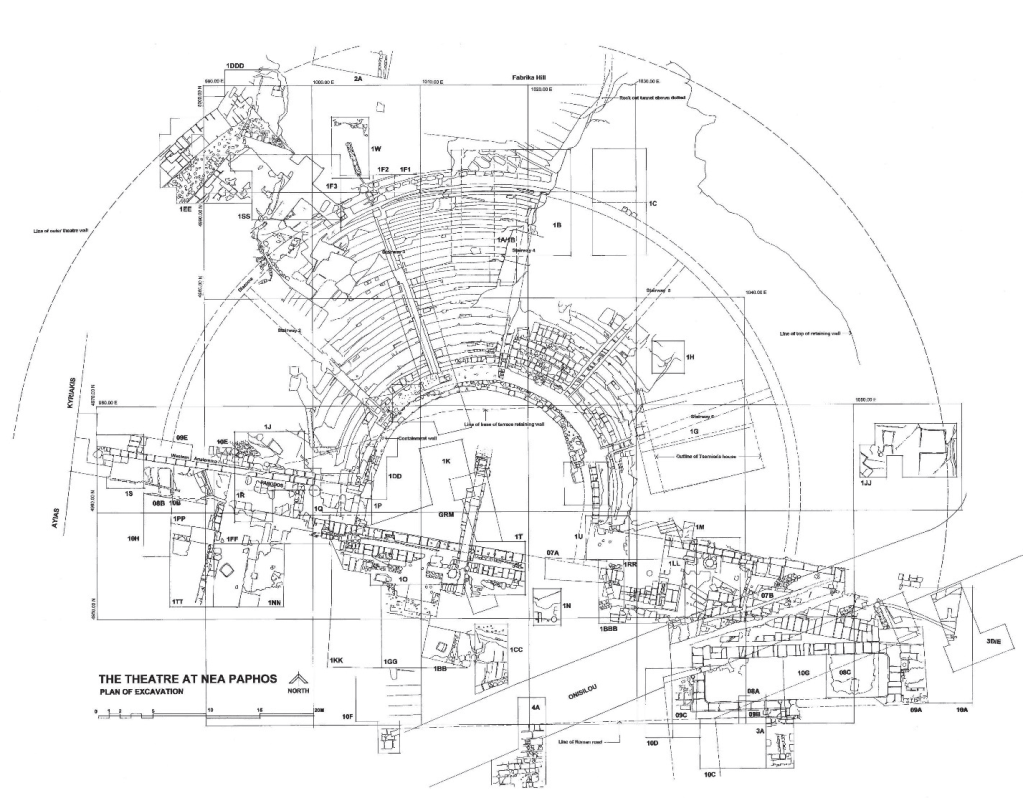
Situated in the north-eastern part of the ancient city, on the southern slopes of the so-called Fabrika Hill, the theatre of Nea Paphos is one of the most significant Hellenistic-Roman architectural features of the city, illustrating the wealth and prosperity of Nea Paphos..
The University of Sydney’ Archaeological Mission to Paphos has been excavating the ancient theatre of Nea Paphos, under the auspices of the Department of Antiquities of the Republic of Cyprus, since 1995. The ”Paphos Theatre Archaeological Project” is directed by Dr Craig Barker with support from Emeritus Professor J.R. Green and Dr Smadar Gabrieli, (Barker, 2012; Barker & Klaebe, 2021).
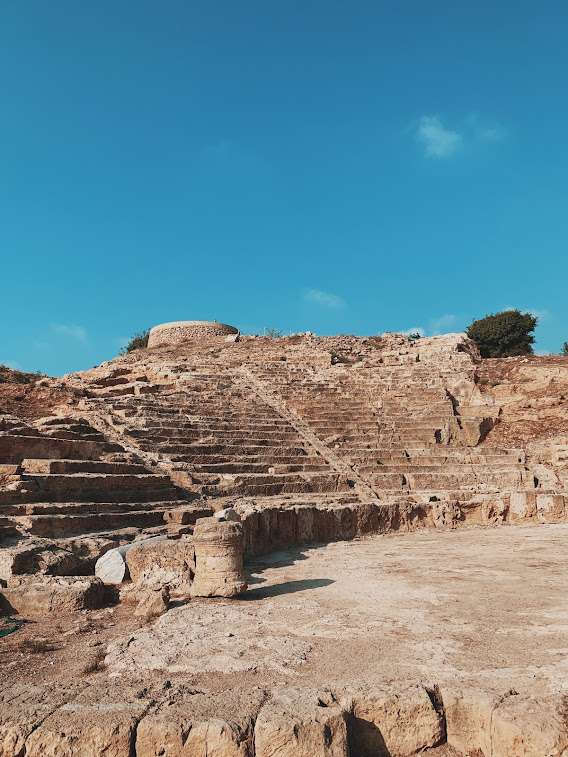
The ancient theatre is situated on the southern slope of Fabrika Hill, near the north-eastern gate of Nea Paphos, overlooking towards the harbour of the city. It was one of the largest structures of the city and the major architectural feature of the north-eastern quarter of Nea Paphos (Barker, 2012). The theatre is a semi-circular structure with the central section of the cavea carved into the natural bedrock of Fabrika hill. According to Baker (2012), the construction of the theatre took place during the time of the foundation of Nea Paphos, in late fourth century BC or slightly later, in the very early third century AD. This is a strong indication of the important role that the theatre would have obtained within the new Ptolemaic koine.
Figure : View of the cavea of the Theatre (c. Cyprus Archaeology)
The structure undergone at least five phased of architectural development. During the middle second century AD, the theatre received its major renovation phase, the Antonine phase. This phase incudes a major expansion [90 meters from one side to the other] and alternations of the stage building. In its greatest extend, it would have had an estimated capacity of 8000-8500 spectators. It was eventually destroyed by the massive earthquake occurred around 365 AD. (Baker, 2012).

The ancient theatre was a venue for performances and entertainment but also a place of interaction and communication of people. Initially it was used for dramatic performances but in its final Roman phases the theatre was converted to an arena and could be flooded for water spectacles (DoA, Press Release 2019).
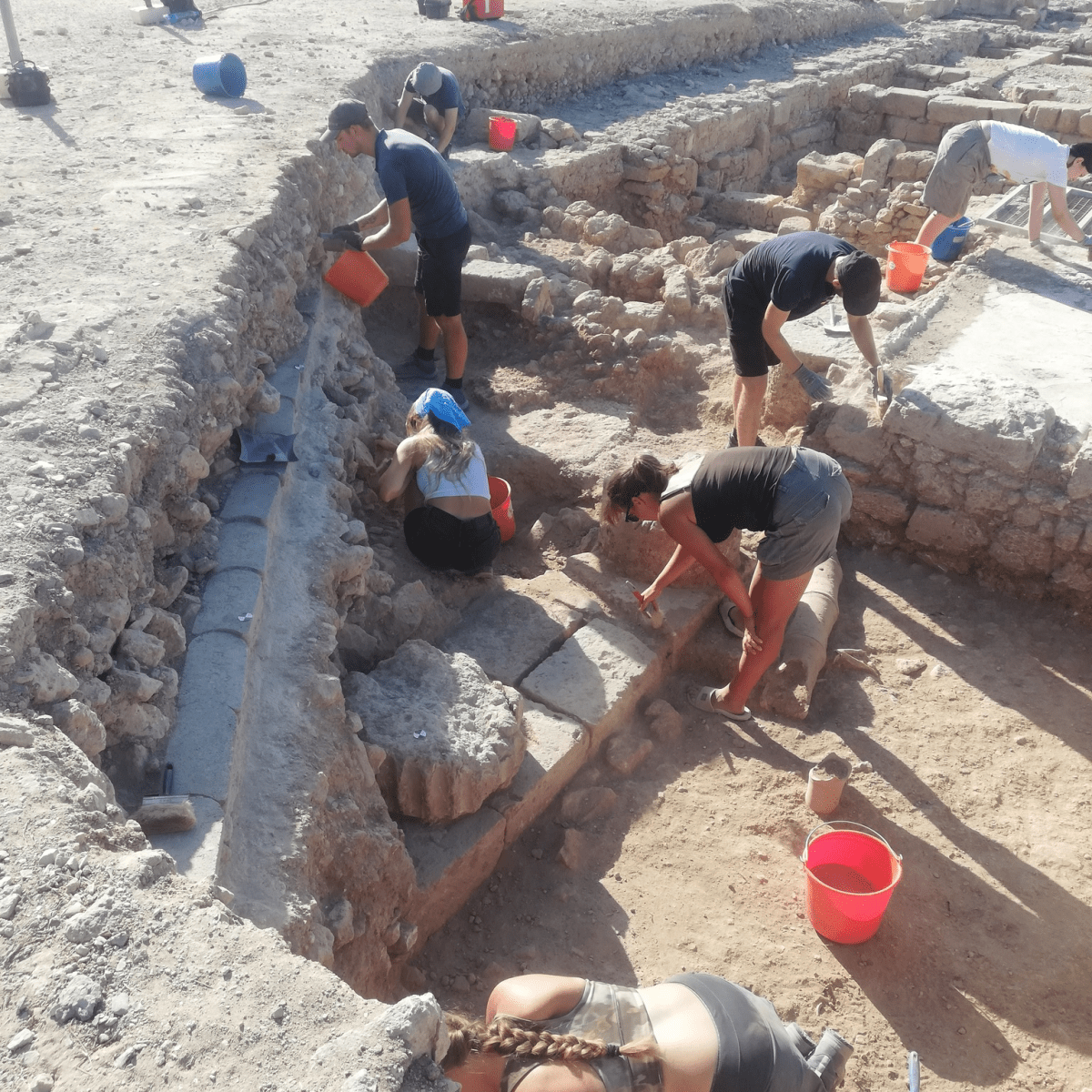
Several elements surrounded the theatre including drains, walkways, facilities and roads. During the last years, the Australian Team focused on the excavation of a wide paved road dating to the Roman period. Wheel ruts indicate it was used by vehicular traffic as well as pedestrian. The road was constructed from rectangular limestone pavers and played a pivotal role in the ancient city’s infrastructure and the movement of ancient populations.
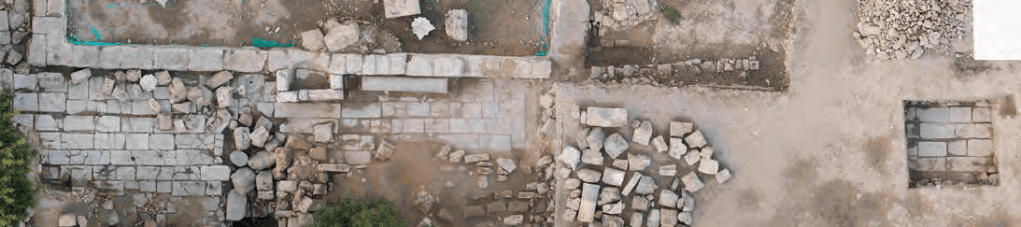
field season. Photo: Dr Rowan Conroy, ( (Baker & Klaebe, 2021).
This paved road seems to be a major thoroughfare with direction east-west, leading to the south of the theatre. The excavations have so far revealed 80 meters length. The road leads to the northeast gate of the city which was part of the pilgrims’ route that lead from Nea Paphos to Palaepaphos. On it west direction, it is likely that the pave road would have lead towards the city, connecting the harbour of Paphos and the agora with the theatre (Barker and Klaebe, 2012). During the Severan period, part of the road would have been colonnaded based on the recording of several Troad granite columns across the ancient city ruins (full report in 2016 AAIA Bulletin).
Research and Text: Cyprus Archaeology Team
Bibliography & Sources
Barker, C. 2012. “The Theatre Precinct of Nea Paphos (Fabrika): Recent Excavations by the Australian Mission”, in: C. Balandier (ed.) Nea Paphos: Fondation et développement urbanistique d’une ville chypriote de l’antiquité à nos jours Études archéologiques, historiques et patrimoniales. Actes du 1er colloque international sur Paphos Avignon 30, 31 octobre et 1er novembre 2012 (Bordeaux 2016), 91-104.
Barker, C. 2016. “Nea Paphos Theatre: 2016 Season”, The Australian Archaeological Institute at Athens Bulletin 13, 2017, 14-15.
Barker, C. & Klaebe, R. 2021. “Paphos Theatre Archaeological Project: 2020 Activities”, The Australian Archaeological Institute at Athens Bulletin 17, 2021, 26-29
Official website of the Mission:
http://www.paphostheatre.org

 cyprus archaeology gazette