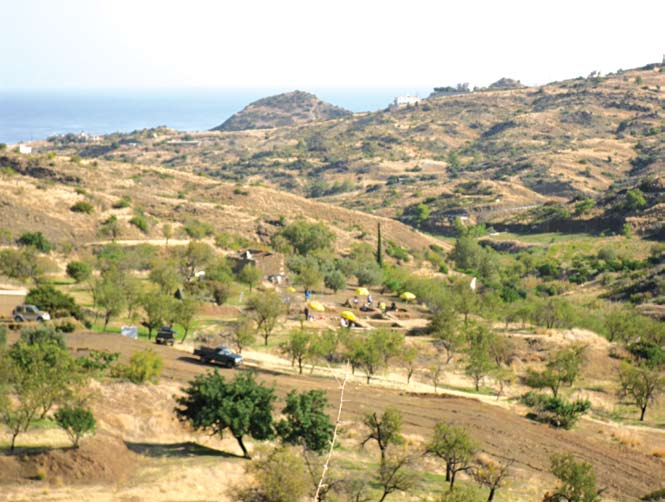
Archaeologist Mr Stylianos Perdikis talks about the discoveries of the archaeological excavation at the site ‘Avli’, at Pano Pyrgos, Tylliria.
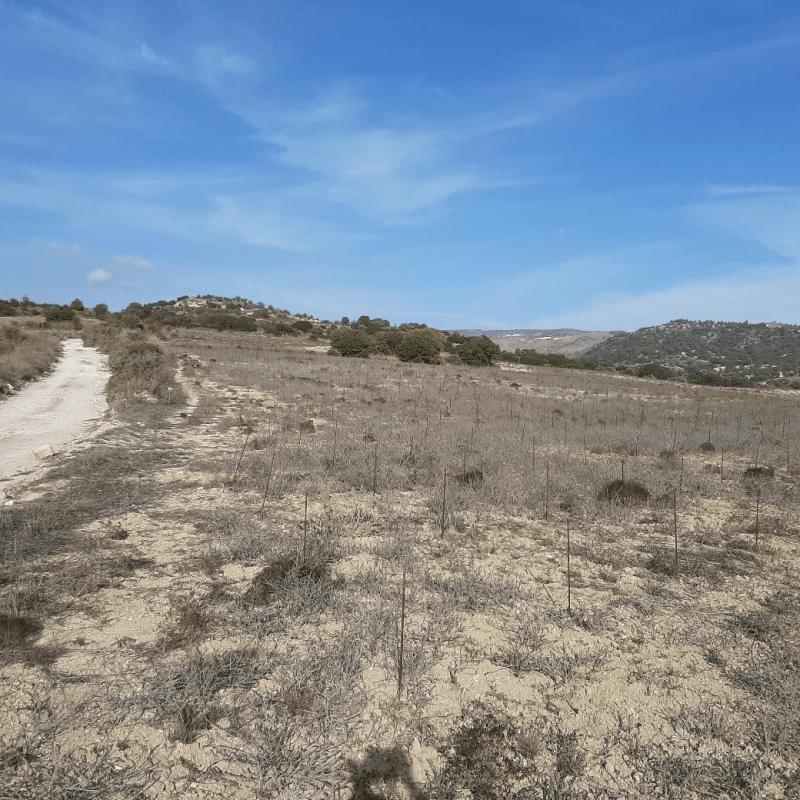
Kato Pyrgos is one of the most isolated areas in Cyprus. It is situated in Western Cyprus and the western Troodos Mountain Rage, and it is an area difficult to access. However, the archaeological remains excavated so far show that this area was inhabited since the 8th millennia BC.
In his interview to CNA, Mr Perdikis, Director of the Museum of Kykkos Monastery and Director of the excavation at the site ‘Avli‘, talked about his work and findings. Mr Perdikis said that the archaeological investigations at the site revealed remains of settlements dating back 8000 years B.C. They also uncovered architectural remains of a medieval complex.
These settlements, he added, have been detected in different areas and they date back to the Aceramic Neolithic period. Additionally, he said that there are settlements dating to the Bronze Age with large cemeteries. These sites indicate continuous habitation throughout the ancient times, extending into the post-Christian era. He also mentioned that in the area, there is an ancient bath. It is located in the Mansoura area and is decorated with mosaic floors and the inscription of ‘Philothalassos’ dating back to the 4th century AD.
Meanwhile, the systematic archaeological excavation at the site ‘Avli’ uncovered a medieval complex which likely was a local feudal mansion. The excavations at the site started in 2008, after permission from the former Director of the the Department of Antiquities, the late Pavlos Flourentzos.
Mr Perdikis said ”we have specifically selected this area because we wanted to get away from the large, well-known ancient centers of Cyprus and see what is happening archaeologically in a remote, agricultural-livestock, poor area of the island”. The excavation is being carried out by the Kykkos Museum in collaboration with the Department of Antiquities. At the same time, it was the intention of Metropolitan of Kykkos Monastery, Nikiforos, who support financially the mission, to support also the local community who was also isolated.
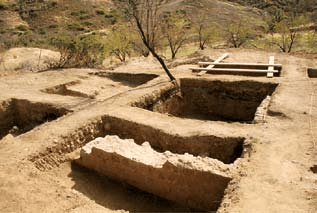
The archaeological site at ‘Avli’ has been detected during archaeological surveys at the area. Mr Perdikis said that since the detection of the site, him with his colleagues and the excavation technician Mr Georgios Koumi, conduct excavations at the site almost every year. The excavation at the site ‘Avli’ brought to light the remains of a large architectural complex of the medieval period.The findings suggest that the site was inhabited since the late 12th century AD, continuing until the 17th century.
The medieval complex comprised of a large-scale rectangular domestic complex which is developed around a large enclosed yard. In its initial phase, according to Mr Perdikis, the building was entirely constructed with rectangular sandstone blocks which were transported from quarries located three kilometers away, on the beach of Agios Theodoros. This would have been very difficult and expensive.
According to the archaeological evidence, the complex was two-story, while some parts also had underground storage spaces. The roof was wooden covered with flat tiles. The rooms of the structure were relatively large, about 30-40 square meters each, with underground spaces and internal staircases. The floors were covered with mortar containing small sea pebbles. In their interior, they were covered in red or ash-colored mortar, a colour that shows the grandeur of the space, he added.
The movable items discover varied. Mr Perdikis said ”We are talking about a domestic space, where usually the findings are limited, unlike what happens in cemeteries. Despite the fact that the area was extensively looted, the buildings were demolished, the building material was moved elsewhere, the land was converted into arable land with olive and almond plantations, we found, at least in a limited number, important findings” . Such examples, he added, are ”a part of a gold-plated metal cover of a wooden box with decorations of dragons”. Among the discoveries were also a silver spoon, with a manufacturer’s stamp that refers possibly to a workshop in Venice, two silver forks, rings, mainly made of bronze with semi-precious stones.
The entire project is nearing completion Mr Perdikis said. One or two parts of the area have not yet excavated. They are also carrying out conservation works so that the space will soon be accessible to the public. In addition, a small botanical garden with Cypriot plants and trees will also be set up in the area.
Closing, Mr Perdikis said that archaeology is a special science with special people. He added that ”Those who work in archaeology have a special passion. You have to love what you do and you have to have a strong archaeological interest. Being given such a license for me personally was something very special. The realization of an elusive dream. We manage to do this in my homeland.”
Sources:
Kykkos Monastery, https://kykkos-museum.org.cy/anaskafes

 cyprus archaeology gazette