The Department of Antiquities of Cyprus, of the Deputy Ministry of Culture, has announced the successful completion of the 2025 excavation season at two significant sites in the Xeros valley: Kophinou Agios Herakleios and Menogeia Limnes. The work was carried out by the Archaeological Research Unit of the University of Cyprus in collaboration with the Archaeological Summer Field School of the Department of History and Archaeology, as part of the ongoing project Settled and Sacred Landscapes of Cyprus (SeSaLaC). Directed by Associate Professor Athanasios Vionis and Dr. Doria Nicolaou, the field season ran from July 1st to 31st, 2025.
Kophinou Agios Herakleios: A Sacred Landscape Across Centuries
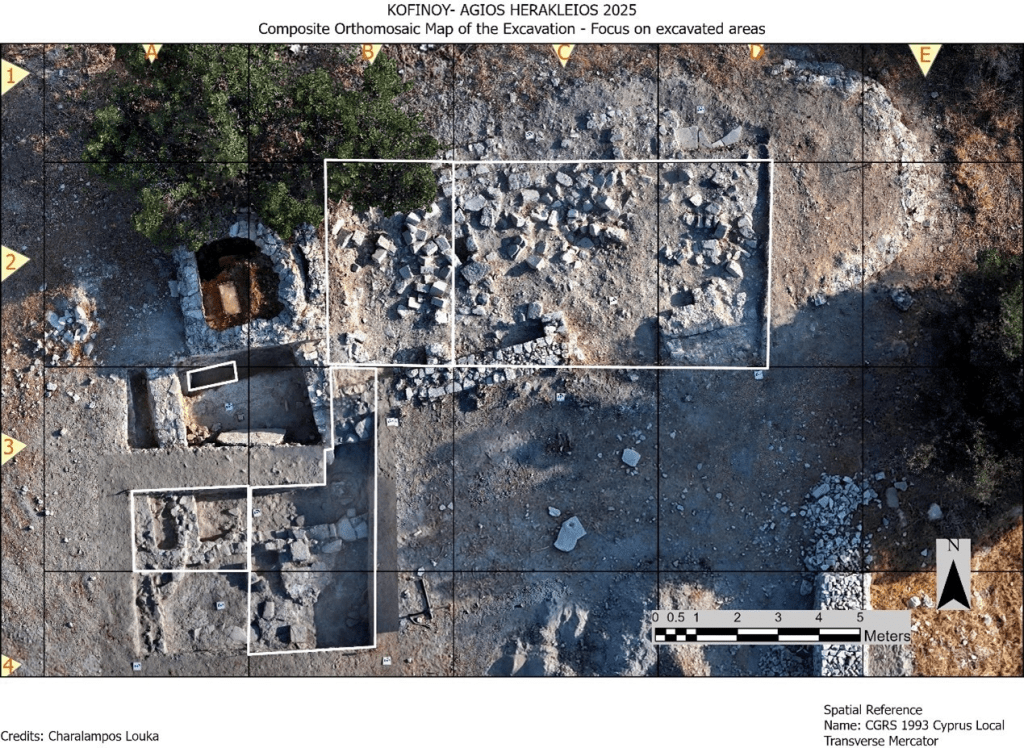
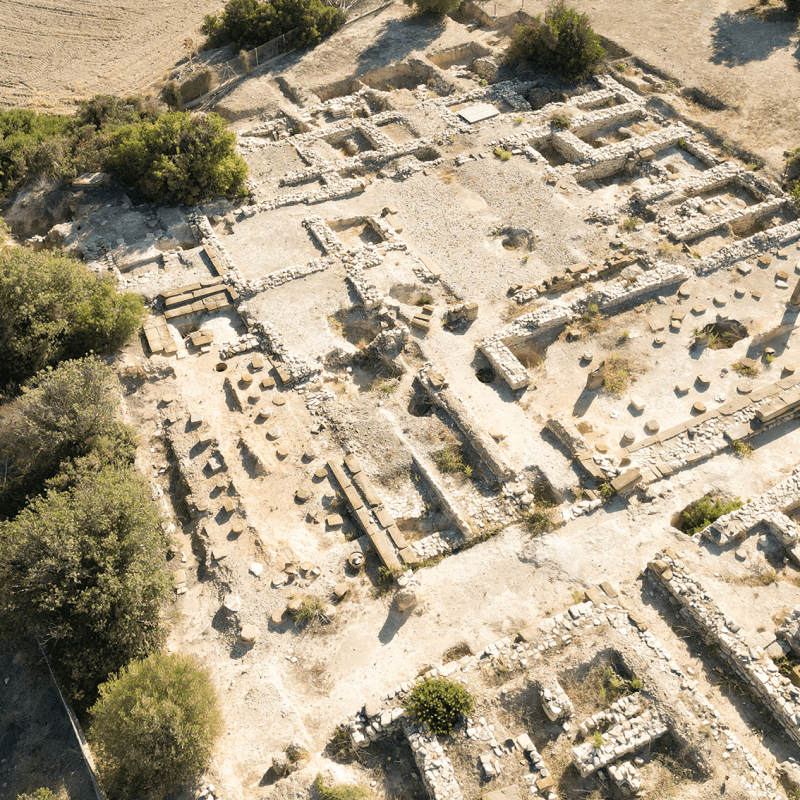
Excavations at Kophinou focused on areas south and east of the ruined chapel of Agios Herakleios, known locally as the martyrion. Archaeologists confirmed that the single-aisled barrel-vaulted church uncovered this season belongs to a later medieval phase, constructed atop an earlier three-aisled basilica dating to the early 7th century AD. The second church was supported by three arches with buttresses, and collapse layers revealed fragments of frescoes and decorated stonework, attesting to its richly adorned interior.
One of the most important discoveries was a burial in a stone larnax from the early Byzantine period, found outside the south wall of the martyrion. The skeleton was preserved in situ, offering insight into burial practices of the time. Additional trenches revealed two parallel walls, likely part of the basilica’s original narthex, while evidence of a hearth and mortar base suggests later reuse of the space during the Late Middle Ages.
Ceramic finds from the collapse layer date between the late 14th and mid-16th centuries, confirming that the site was continuously used from the 6th to 16th century for ritual, burial, and domestic purposes. Importantly, the excavation documents for the first time in Cyprus the existence of an organized cemetery around a rural basilica, likely established in the 6th–7th century AD.
Menogeia Limnes: the pottery workshop
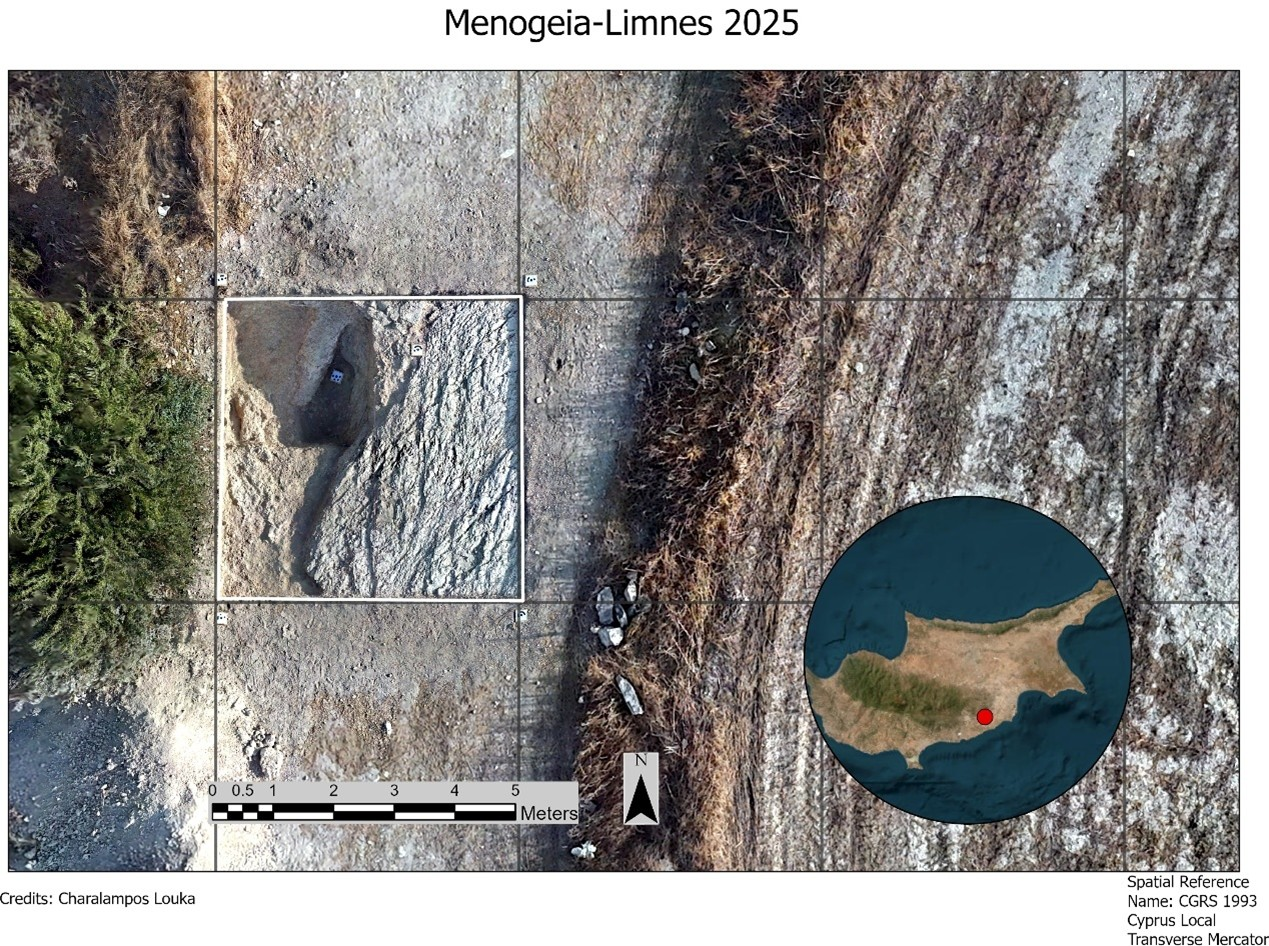
At Menogeia Limnes, investigations focused on a trial trench at a site identified as a pottery workshop. Archaeologists uncovered concentrations of pottery wasters, unfired clay, and combustion residues, alongside a circular notch cut into natural rock, interpreted as part of a kiln installation. Associated finds included charcoal, glass fragments, and metal debris, all pointing to the site’s function as a rural industrial hub during the 5th–7th centuries AD.
At Menogeia Limnes, investigations focused on a trial trench at a site identified as a pottery workshop. Archaeologists uncovered concentrations of pottery wasters, unfired clay, and combustion residues, alongside a circular notch cut into natural rock, interpreted as part of a kiln installation. Associated finds included charcoal, glass fragments, and metal debris, all pointing to the site’s function as a rural industrial hub during the 5th–7th centuries AD.
Source: Department of Antiquities of Cyprus, https://www.gov.cy/en/culture/completion-of-the-excavation-at-the-site-of-kofinou-agios-herakleios-and-menogeia-limnes


 cyprus archaeology gazette