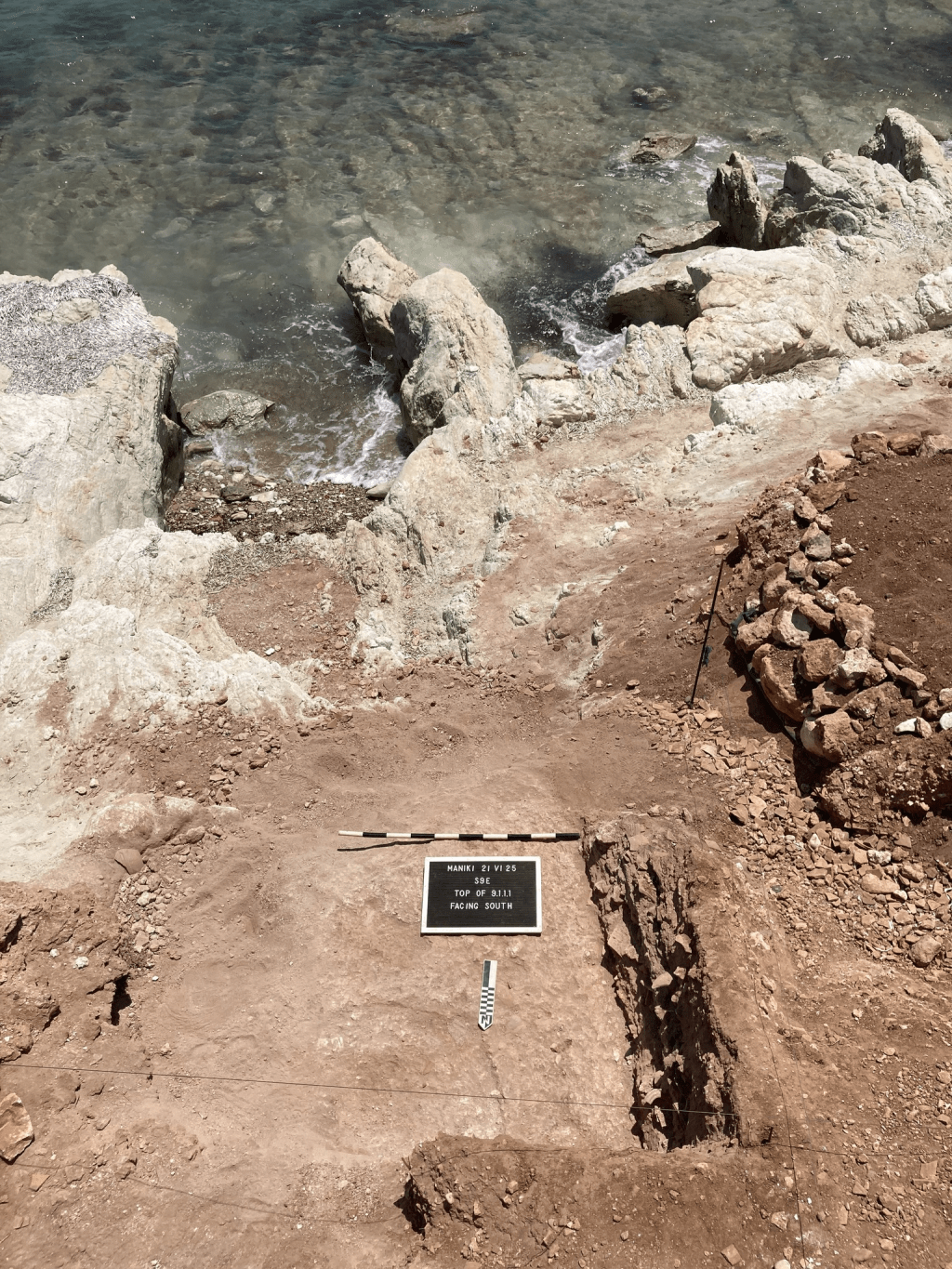
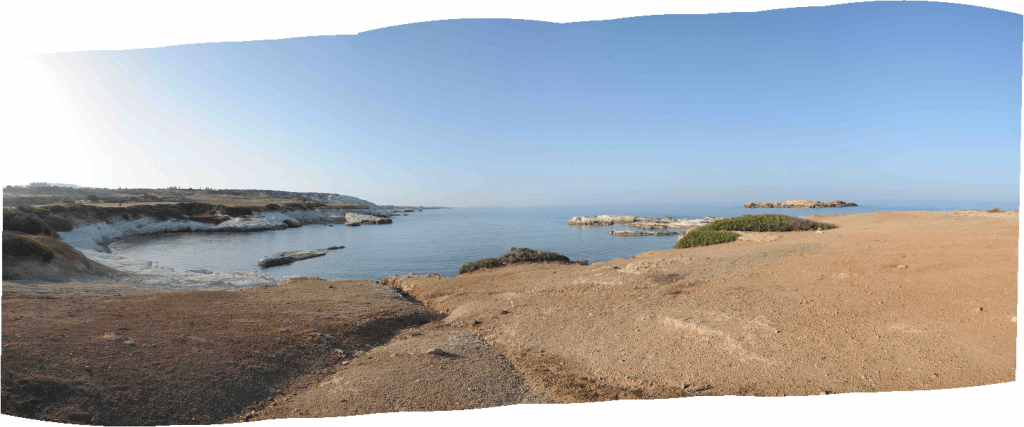
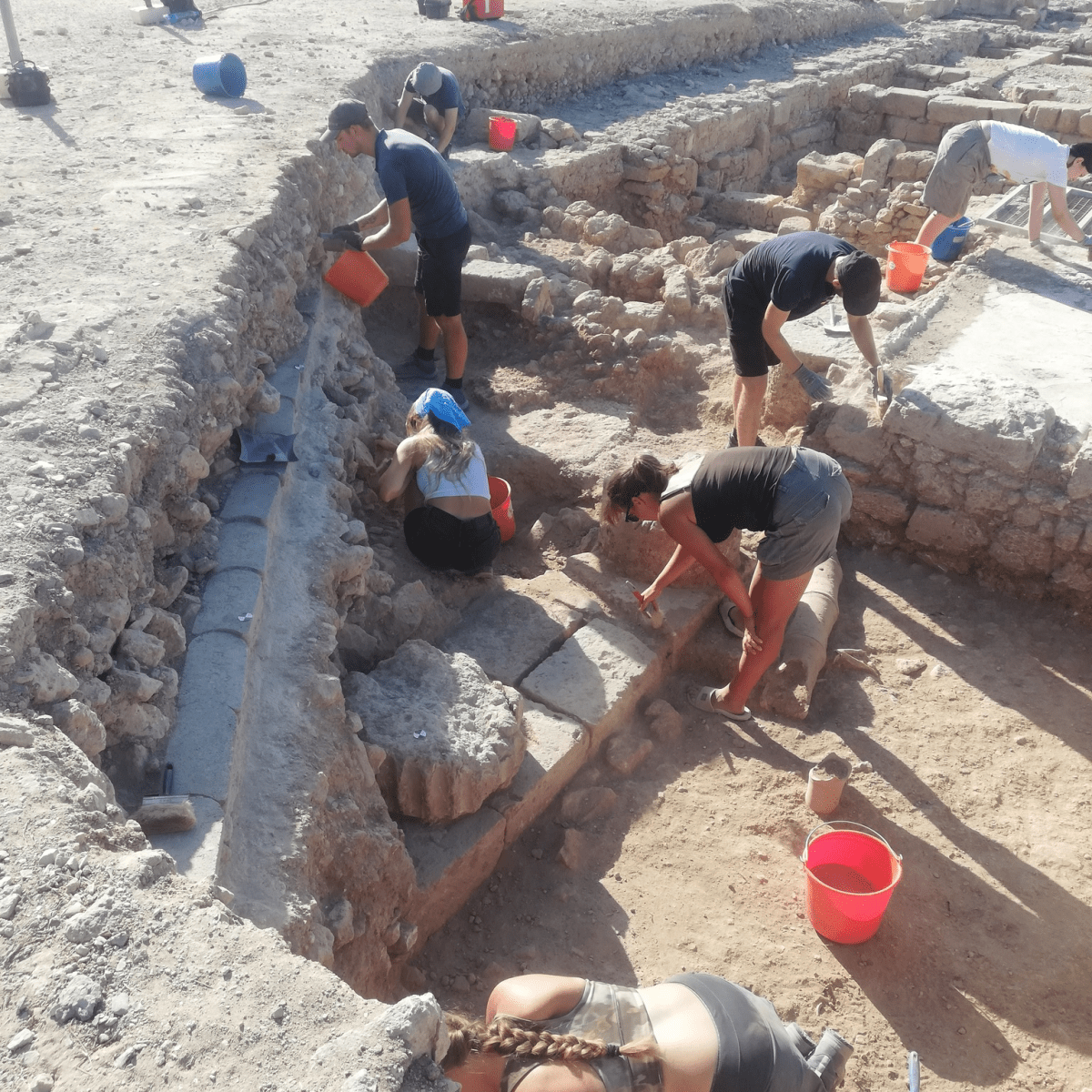
The Department of Antiquities of the Deputy Ministry of Culture announced the completion of the 2025 field season of the New York University (NYU) Archaeological Mission at Agios Georgios, Pegeia. The mission was directed by Professor Joan Breton Connelly. The six‑week campaign combined excavation, survey, and specialist study. It focused on the ancient harbor of Maniki. It also looked at the wider funerary landscape of the Pegeia‑Meletis region.
The project involved an international team. Scholars and students from NYU, the University of Cyprus, and The Cyprus Institute participated. They engaged in a multi-disciplinary research and publication program.
Prof. Stella Demesticha of the University of Cyprus (Archaeological Research Unit, UCY – Ερευνητική Μονάδα Αρχαιολογίας, ΠΚ) directed the identification, classification, weighing, and quantification of over 700 kilos of Late Roman amphorae sherds excavated by the NYU Geronisos team. The assemblage is dominated by Late Roman 1 amphorae of local Paphian and Cilician production, supplemented by imported Palestinian LR4 and LR5 types from Gaza, all dating to the 6th century A.D.
A particularly significant discovery is the presence of 68 red‑painted dipinti on the amphorae. While such inscriptions are known elsewhere in Cyprus, they remain understudied for this period, making the Maniki corpus a promising dataset for future research.
The amphora sherds appear to have been intentionally dumped as constructional fill, used to level the steep bedrock in order to build harbor installations and piers. These facilitated the delivery of great quantities Proconnesian marble blocks, column drums and capitals for the basilicas constructed at Cape Drepanum under the Emperor Justinian in the 6 th century A.D.
Study of the Hellenistic–Roman Rock‑Cut Tomb
A second major focus was the continued investigation of a rock‑cut tomb discovered in 2018. The tomb spans a long chronological range, from the 1st century B.C. to the 5th century A.D.
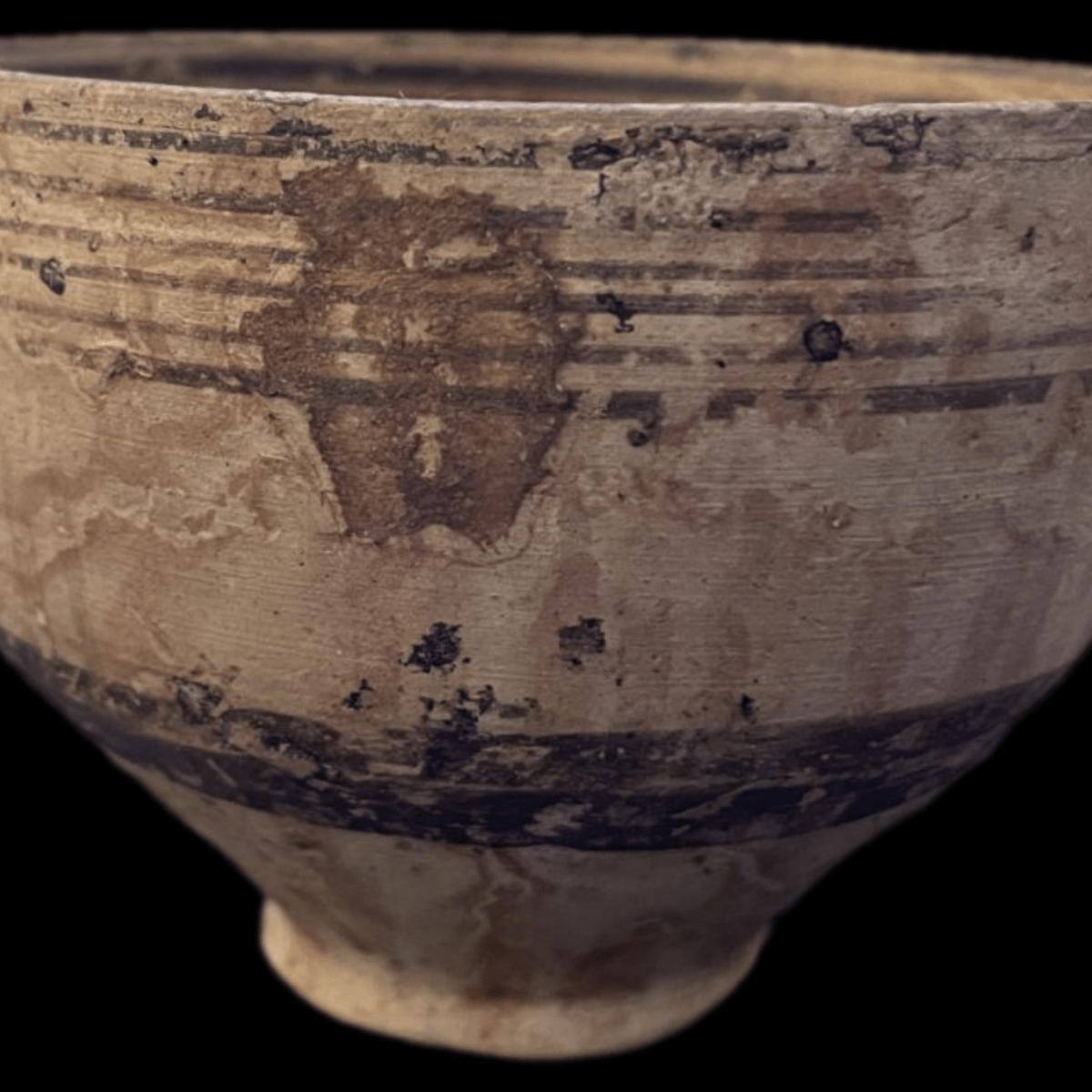
- Ceramics: Prof. Jolanta Mlynaczyk (University of Warsaw) continued her important work on the tomb’s ceramic sequence which dates from the 1st century B.C. to the 5th century A.D.
- Organic residue analysis: Dr. Rebecca Gerdes (Institute of Archaeology and Material Sciences, Cornell University) sampled Roman cooking pots for organic residue analysis. Her results may deepen our understanding of local dietary practice as well as funerary and banqueting rituals.
- Glass vessels: Dr. Mariusz Burdajewicz (University of Warsaw) documented a rich assemblage of glassware dating from the mid-1st century B.C. to the late 2nd/very early 3rd century A.D. Most belong to the Roman Imperial period and include cast glass ribbed and linear-cut bowls and well as blown glass bowls, cups, beakers, dishes, bottles, juglets, and unguentaria.
Despite extensive looting from antiquity through the 20th century, the NYU team recovered precious metal objects in situ. These are now under study by Dr. Marianna Dági (Head of Collections and Chief Curator of Antiquities at the Museum of Fine Arts in Budapest), in collaboration with Dr. Thilo Rehren and Dr. Meghna Desai of the Cyprus Institute’s Science and Technology in Archaeology and Culture Research Center (STARC – Science and Technology in Archaeology and Culture Research Center) who have conducted XRF analysis and will soon begin SEM work.
The human remains discovered in the tomb were analysed by Dr. Efi Nikita of the Cyprus Institute. The animal bones are under study by Dr. Paul Croft, Special Scientist at the Archaeological Research Unit, University of Cyprus. The remains include numerous sheep, goat, pig, hare, fish, and chicken bones. These were deliberately introduced during the tomb’s funerary phase. Many of these are heavily burnt, shrunken and distorted, suggesting the deliberate incineration of what may be offerings to the dead or meals consumed by the living.
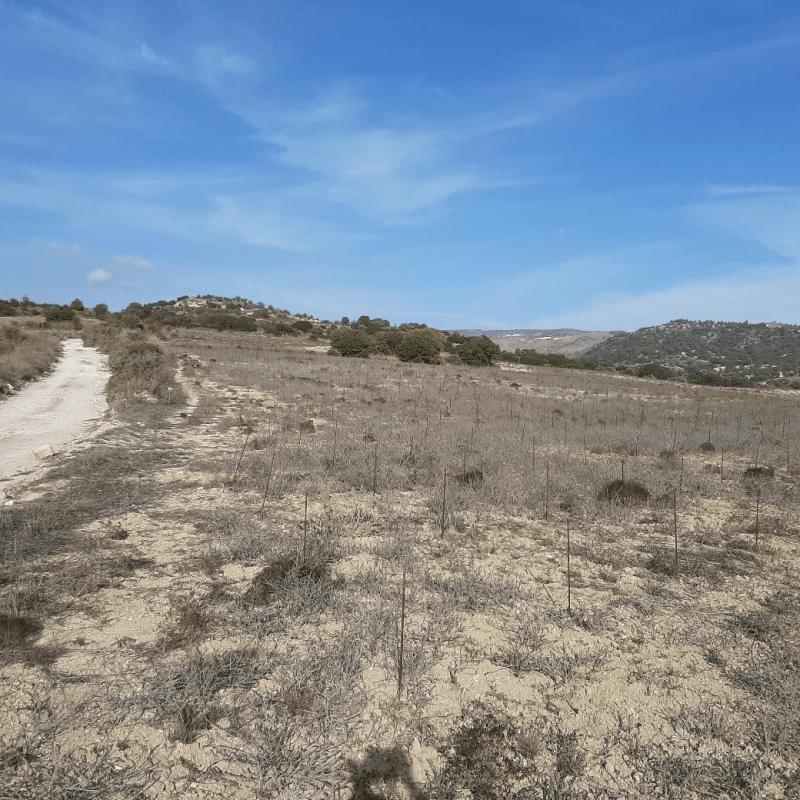
Prof. Thomas Tartaron (University of Pennsylvania) led students in a surface survey of the Meletis Necropolis, building on his 2018 work when the tomb was first discovered. He is preparing comparative studies of the 2018 and 2025 surveys, as well as earlier surveys around Maniki Harbor (2018–2019), for publication. Tartaron also continued the Pegeian Fishermen Oral History Project, interviewing local fishermen who worked from Maniki Harbor in their youth, preserving valuable community memory.
The season concluded with an informal survey retracing the 1889 journey of David George Hogarth, as described in Devia Cypria. Prof. Connelly, joined by George Marshall Peters (Explorers Club) and Prof. Lorenzo Calvelli (University of Venice), followed Hogarth’s route across Cape Drepanum and the Meletis Forest Necropolis, revisiting his observations with modern archaeological insight.
Sources and Images:
Department of Antiquities of Cyprus

 cyprus archaeology gazette