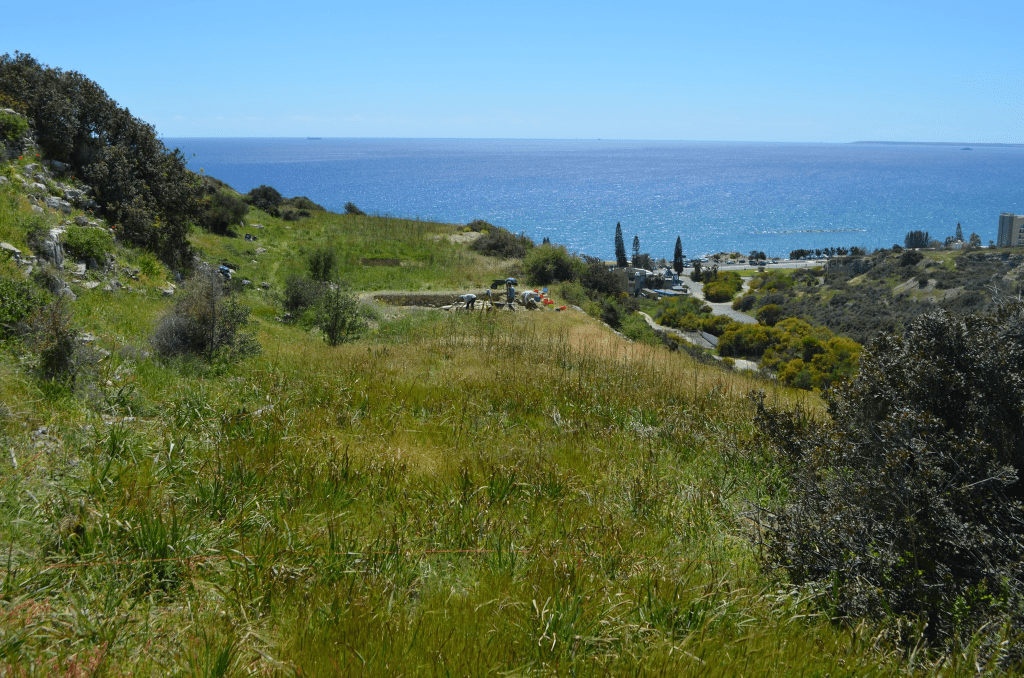
The French archaeological mission at Amathous—carried out by the French School at Athens, the French Ministry for Europe and Foreign Affairs, and Laboratoire HiSoMA, MOM, Lyon—completed its second excavation season on the West Terrace of the acropolis between 30 March and 24 April 2026. The work was directed by Dr Anna Cannavò (HiSoMA, MOM, Lyon).
Expanding the 2025 Discoveries
The current investigations build on a geophysical survey conducted in 2024 and the first excavation season in 2025. During that initial campaign, archaeologists uncovered a small section of a north-south oriented wall in the central part of the terrace within Trench 1 (“sondage 1”), associated with a substantial collapse layer and a concentration of well-preserved Late Roman roof tiles.
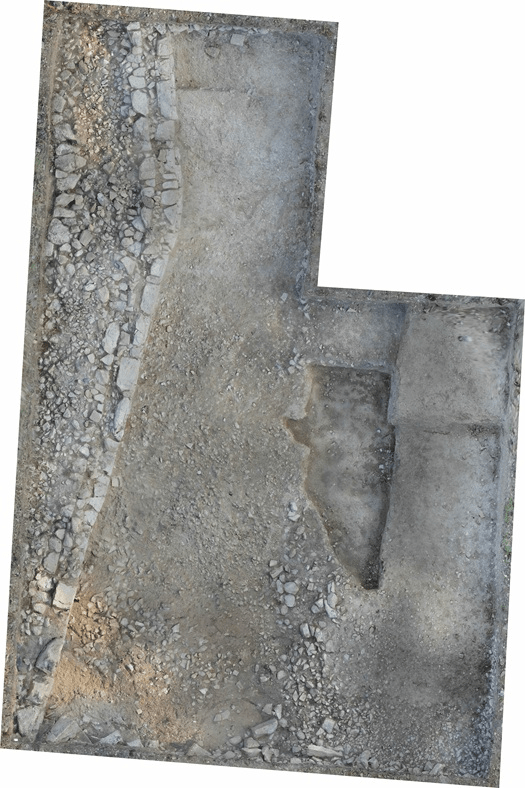
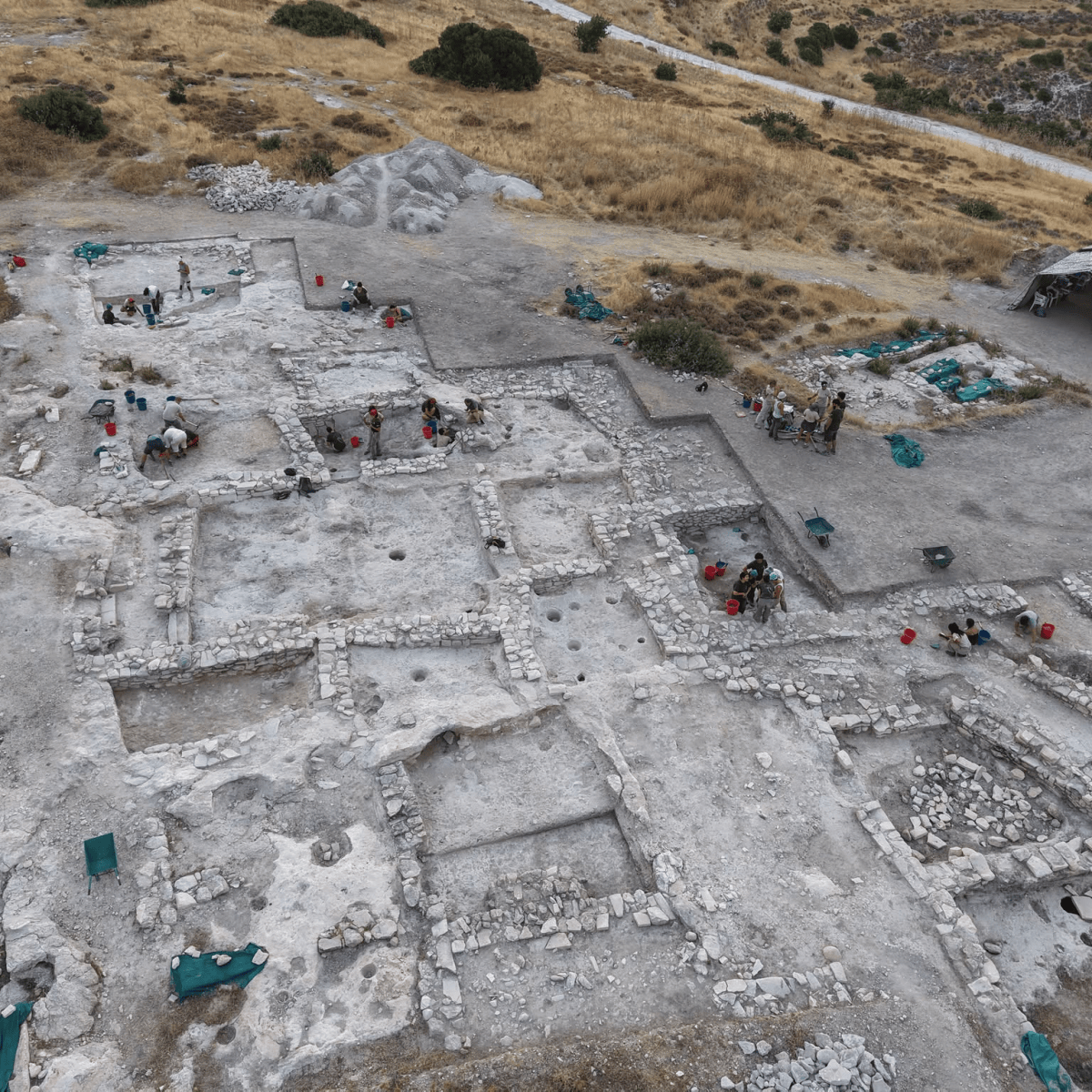
In 2026, Trench 1 was enlarged—extending 4 m north, 1 m south, and 1 m west—reaching a total area of 12 × 8 m. This expansion exposed a longer segment of the north–south wall along the western side of the trench. The structure runs parallel to the natural edge of the terrace and curves slightly westward at its southern end. Its eastern face is made up of large limestone blocks, some of them partially cut to a roughly regular shape, held together by soil.
Figure 2. Aerial view of Trench 1
The wall itself is an imposing construction, measuring 2 m in thickness and preserved to an average height of 50 cm. Its eastern face consists of large limestone blocks, partially cut to a roughly regular shape, held together by soil. The filling of the wall is composed of small and medium limestone rough stones packed together with soil.
Excavation revealed two distinct construction phases. The original wall, 1.35 m thick, was later strengthened by an additional row of large limestone blocks on its eastern side, separated from the earlier face by a 10–20 cm fill layer. A small sounding realised in the northern part of the area, to the east of the wall, brought to light its foundations. Associated to the wall is a floor, situated to the east, which was partially paved with roof tiles; a preparation layer of small, compacted gravels was exposed. Based on the material recovered, consisting mainly of transport amphorae and roof tiles, the wall and its associated floor can be dated to the Late Roman period.
Evidence of Destruction
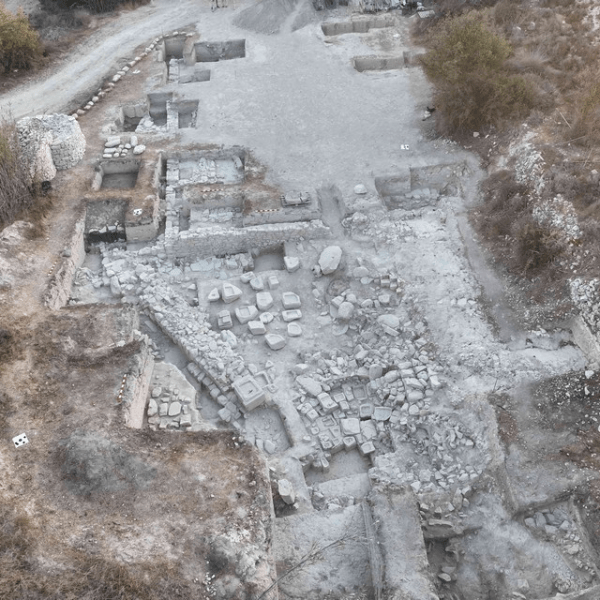
To the east of the wall, a destruction layer was excavated. It contained numerous large limestone blocks, some originating from the wall structure itself and others reused from other buildings. The layer also yielded a remarkable quantity of roof tiles, many preserved in very good condition, as well as clear traces of mudbrick from the wall’s upper structure. The western face of the wall has not been excavated, as it lies close to the terrace edge and its exposure could provoke a collapse.
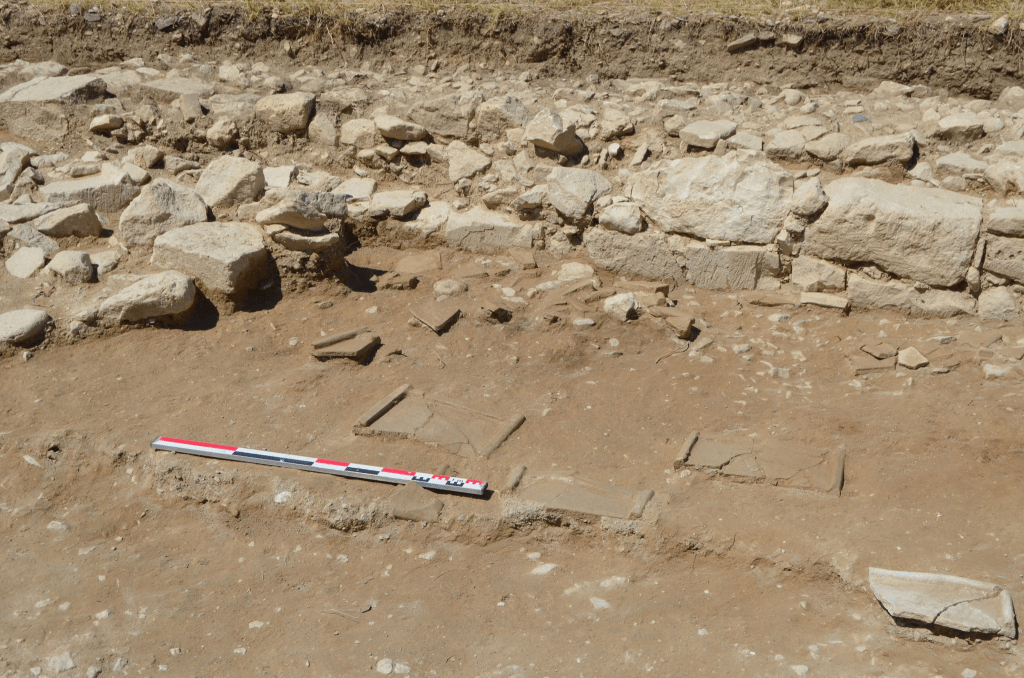
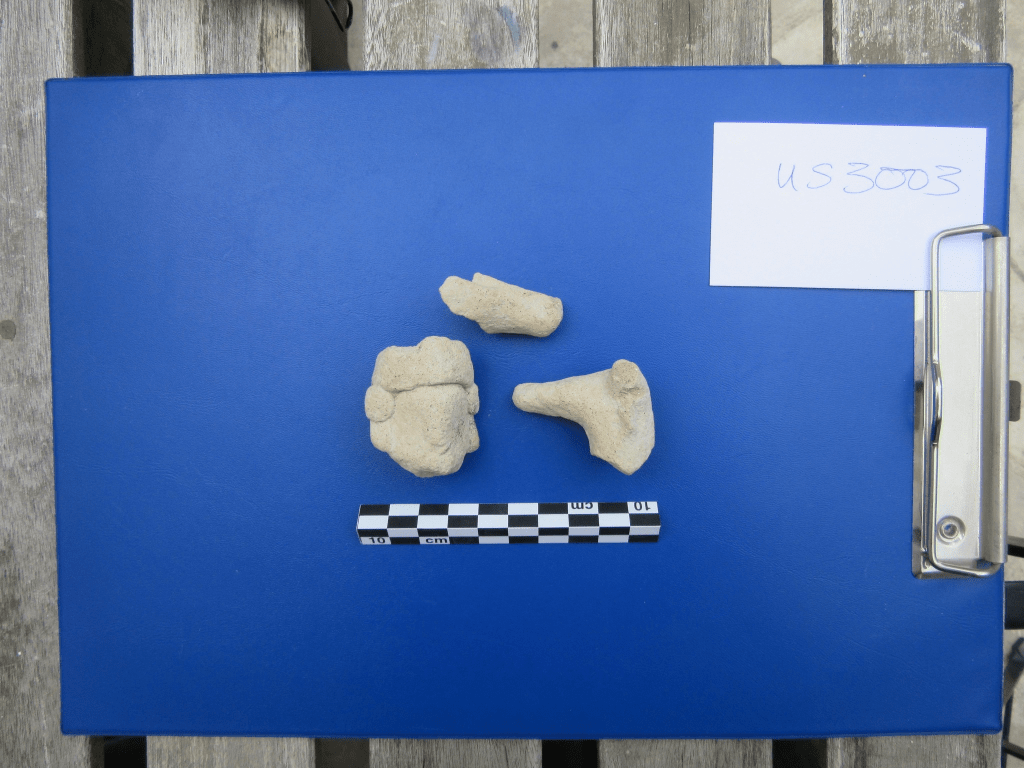
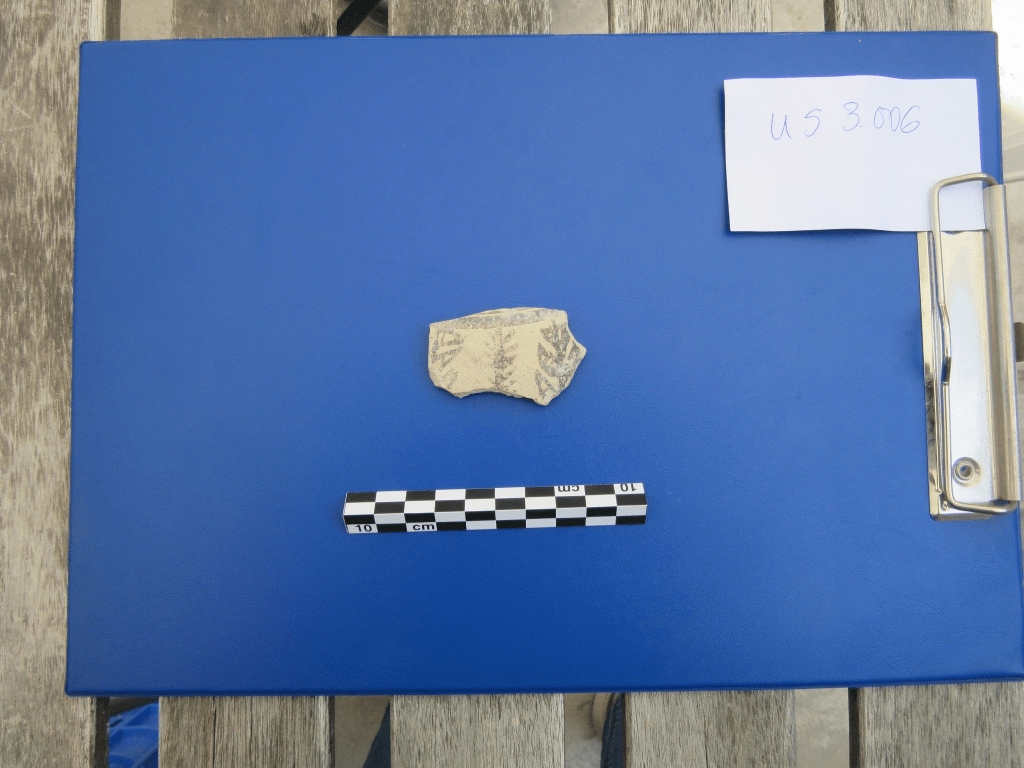
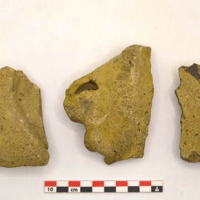
Image 4 (middle): Iron Age terracotta figurines (“Amathous style”) from Trench 3.
Image 5 (right): Iron Age pottery (“Amathous style”) from Trench 3.
Trench 3: Iron Age Material on the Northern Edge
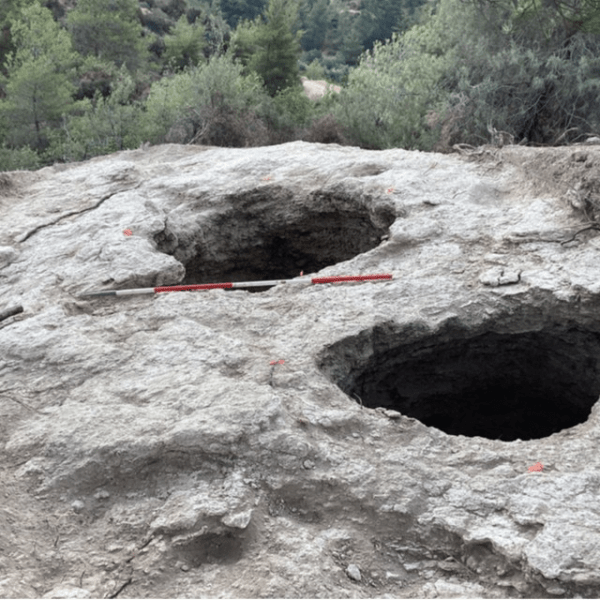
A second excavation area, Trench 3, was opened on the northern edge of the terrace, overlooking an Archaic fortification wall previously excavated in 1976–1977 by the French mission. Although no architectural remains were identified within this 5 × 5 m trench, its deep fill contained abundant Iron Age material.
The evidence brought to light during the 2026 campaign confirm the importance of the occupation on the Terrace during the Late Antique period. The wall appears to have had a defensive character, thus indicating the need to protect the upper part of the acropolis and the basilica which succeeded the sanctuary of Aphrodite. Whereas the western slope of the acropolis is steep, it is not entirely inaccessible and therefore required additional protection in case of danger. Future research will allow to understand the layout of this defensive structure, and the nature of the spaces located to its east, to which belong the paved spaces and the roof remains. It will also allow to find out if this architectural element was built upon earlier structures.
Source and Images:
– Department of Antiquities